Everything You Need to Know About Chi Sao
The 80-20 Principle of Chi Sao
Over 80% of successful strikes, defenses, or both are from doing only less than 20% of the basic Wing Chun techniques we first learn. In Chi Sao, it’s no different.
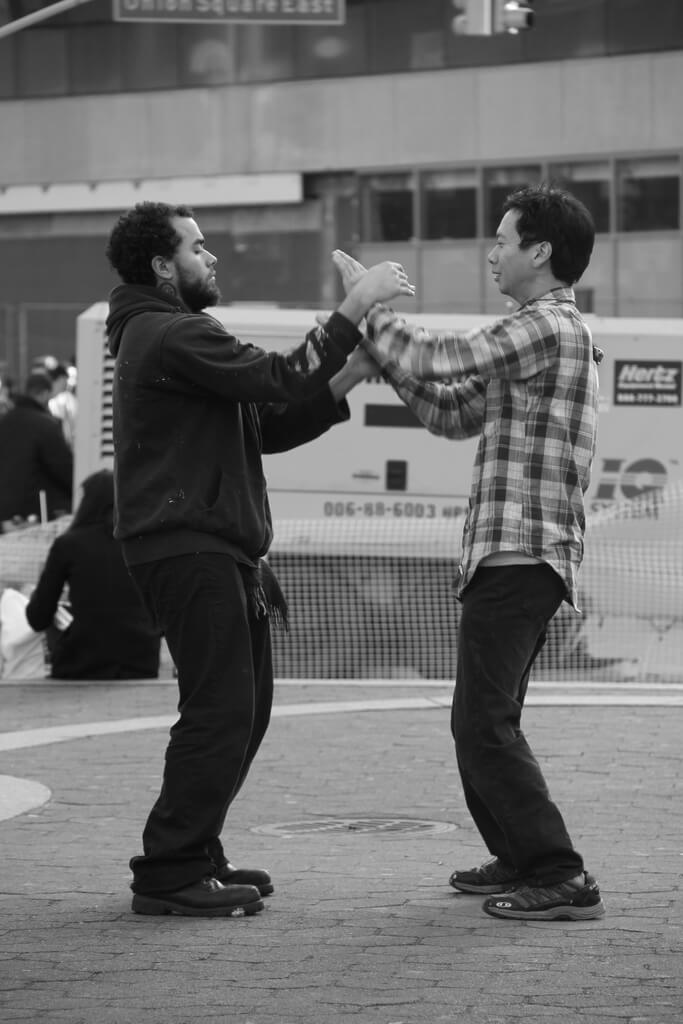
Chi Sao (Sticky Hand) is a Wing Chun drill that can be considered as light sparring. In Chi Sao, we learn how to effectively gauge sensitivity as well as actually striking and defending against a partner but we tend to do flashy or overcomplicated attacks when we Look Sau (roll our hands) during Chi Sao. Most of the time a simple Pak and Punch is enough to get to the opponent. But why do we learn all these other techniques in Chi Sao if we’re only going to be only using the same few techniques 80% of the time?
The reason is because we learn different techniques is so when we train with a partner we are helping them react to different attacks. It also teaches the sensitivities of different type of attacks so when we feel an attack come a certain way, we logically connect them to the defense drills that we’ve practiced over and over.
Master your Chi Sao Technique
By doing the same few techniques over and over, you’re building muscle memory for those techniques and this will help you improve and master them. If you have heard that it takes 10,000 hours to master a skill, well in Chi Sao, by doing a single type of attack or defense repeatedly 10,000 times should be enough for you to own that skill and to be very comfortable doing it. When doing your techniques come natural to you, it allows you to start focusing.
Think about your own Chi Sao training sessions. Think back about when you Chi Sao and the techniques you use and the effectiveness of the ones that you use the most often. You know the one I’m talking about. It’s the one technique that you have the highest success of striking and the least amount of success your opponent has defending. If you’re already aware of what technique you use that is effective, the next step you need to do is focus on the why.
The reason this is important is because once you realize what your strengths are, you can now focus on your opponents’ weaknesses and why they’re failing to defend against you. If your technique is successful against the majority then the majority has the same weaknesses. Help your fellow Wing Chun practitioners out. Tell them where they need improvement and show them why they’re unsuccessful. They will be thankful because it’s hard to realize our mistakes and address a solution.
Feel free to comment below on your Chi Sao training and if the 80-20 principle applies to your Wing Chun.
Psychology in Chi Sao
Here are some notes I wrote down where I focused on Chi Sao and it’s psychology when practicing with a partner. It definitely made class more interesting and had me very anxious to practice Chi Sao!
General
Practice with force in class because it’s the only place where it’s safe to do so.
Psychology
- Lead with a strike so the opponent feels danger and react to it
- Make the opponent react. The goal is always to make the opponent move because if they don’t move then they’re not in any danger and if they’re not in danger, my attack is useless
Chi Sao
- If you begin flailing arms when you’re not in a good position, reset and find the best position to be in and go from there
- Once you feel the opponent preparing something, go with the flow but counter them
- If one arm is blocking the other needs to be striking
- Four quadrants, do not cross quadrants
- When striking, imagine striking through and past them
Additional Notes
- Don’t hesitate rolling when arms are switching in between rolls. Practice rolling in and out without hesitating when switching.
- Always make sure Tan Sau and Bong Sau has 135 degree angle where the elbow bends.
- Fook Sau is relaxed from forearm to wrist.
- When both my arms are resting on opponent’s, follow with arms and not the elbows. Don’t bend elbows. Move with the rolling by raising or lowering the Fook Sau arm.
- Keep Fook Sau in the centerline. Stick wrist to opponent’s wrist.
- Keep fingers together to avoid them from being grabbed or jammed.
- When rolling, transitioning from resting hand to rolling hand, pull in and shoot out when opponent is about to roll into Tan Sau
- Roll to top when I’m in Tan Sau and lead with the thumb out
- Bong Sau doesn’t stay static. Once block connects, flip to Tan Sau
- Step in and lead with strikes
- Never pull unless it’s Lop Sau
- Pin opponent, push into them. Bump them
- When pinning opponent’s arm, make sure that my arm crosses theirs and it’s not parallel
- Lead with strike first
- Step in with weight on the back leg
- Roll with a tune or beat
- Tan Sau + Bong Sau roll is done as if there is a ball between the hands where each wrist overlaps the other
- Use elbow to damage or pin opponent. The idea is to use every part of the body, if possible, for maximum efficiency.
- Tan Sau should hurt the opponent. Blocking should make the opponent think before the next time they strike.
- If my arms are pushed outside, Pak opponent’s arm and use my sticking arm to roll out and strike. Always look for openings and don’t wait on opponent’s next move; don’t wait, initiate.
- Fook Sau is 135 degree
- You miss 100% of the attacks you don’t make
Final Notes
Chi Sao was very enjoyable this month because of the new perspectives that my Sifu introduced. I believe the psychology behind Chi Sao is very important: Make the opponent react then exploit their reaction.
Dealing With Frustration During Chi Sao
For me, it happens at least once per class when I am doing Chi Sao with a junior or senior student partner. They would throw attacks where I can’t find a counter, or answer, to them and I get stuck. I know a possible solution is to use my strength or speed to get out of the situation but one principle that I’ve been training by is one that my Sifu always says. He says to not rely on power or speed but rely on good technique.
It’s a hard principle to follow because my instincts are always to rely on my strength and speed. Even so, I stop to think of a solution by only relying on my techniques. Of course, this doesn’t always work because a lot can happen in a moment during Chi Sao. In this episode, I share two examples.
Look at My Eyes When I Chi Sao With You
Eye contact is hard.
Try making eye contact with strangers on the streets. My initial reaction is to look away.
It’s hard to maintain eye contact because it’s usually for people I’m close with: friends, family, colleagues.
In Wing Chun class though, it’s even more difficult because during drills or Chi Sao, my opponent is literally a feet away. It feels uncomfortable to maintain eye contact at such a close range. So instead, I would stare at my opponent’s hands. I would also stare everywhere else except my opponent’s face and eye area. And I wasn’t the only one, other people in my class would look to the side of me or past me (because they were taller than me).
I think it’s important to work past this because I believe we can see a person’s intent through their eyes. Also by focusing on the face area of my opponent, I have the peripheral view of their body so when they’re about to do something, I can see it coming.
Let me explain. I think that the farther the movement is from the brain, the easier it is to spot it, if you’re looking.
For instance, let’s use a straight punch. If you look at my punch, you can see the movement from my neck first because I start tensing, then my shoulder raises, my biceps flexes, my elbow extends, then finally my fist.
The hands are the last thing that moves when a strike comes.
If I’m spending my time just staring at my opponent’s hands, I am already too late and my opponent has already thrown the punch. All I can do is avoid it by blocking, shifting, or deflecting. I think that’s where the term “chasing hands” comes from.
This is How I Roll in Chi Sao
The first thing I learned for Chi Sao was one hand Chi Sao (Dan Chi Sao) then the second thing was rolling.
I think rolling is very important in Chi Sao because it sets the tempo and also tests our sensitivity. So I want to share my 4 rolling states:
- Left arm Fook Sau, right arm rolls Tan Sau to Bong Sau.
- Right arm Fook Sau, left arm rolls Tan Sau to Bong Sau. The opposite of the first state.
- Inside roll, left and right arm Tan Sau to Bong Sau so that they’re both alternating. This mean there will never be two Tan Saus or two Bong Saus. It’s always one Tan Sau and one Bong Sau.
- Resting position, both arms in Fook Sau. This makes my opponent go into the inside roll and allows me to rest and recharge momentarily.
There are also 2 key things to keep in mind while rolling.
- Maintain a steady pace. If my opponent changes the speed that they roll, I have a feeling that they’re up to something and may be about to strike.
- Maintain a steady pace. I know I already said this but if I’m the one to change the pace, now my opponent know’s something is about to happen. I hope this makes sense.
I didn’t know people rolled differently than I do. So I’m curious to find out how you do it! Let me know, in the comments, if you roll the same way or go about it differently!
Eyes Closed Chi Sao
The idea behind Eyes Closed Chi Sao (ECCS) is to shut out all your visual distractions and focus on finding openings created by your opponent.
When I first tried this, it was scary because I couldn’t see what my opponent was going to do with my eyes closed. But when I got used to it, it made it much easier to focus on my opponent’s intent. I don’t know how to describe it any other way but “intent”. I could feel when my opponent is about to step forward or strike, etc. This was because my eyes were closed, I could no longer rely on my sight but had to use my other senses to Chi Sao.
It’s a very fun drill and I encourage you to try it out with your training partner. Go soft so you don’t hurt each other, especially if it’s your first time. Just roll and see if you can find each other’s openings and try to strike when the opportunity presents itself!
Using a Rash Guard in Wing Chun
It’s summer in New York and it gets really hot in class. This leads to a lot of sweating and it makes training a bit messy when I’m sliding off my opponent’s sweat.
I’m trying out the rash guards (or as I like to call them, Chi Sao Guards) and here’s what I think so far:
- It keeps my sweat separate from my opponent and my arms no longer slide off my opponent’s arms during drills and Chi Sao.
- I’ve never wore long sleeves in class before so wearing these rash guards has been my first experience with sleeves in Wing Chun. I find it uncomfortable and prefer using only my arms.
- It doesn’t affect my sensitivity or my techniques but once again, it feels different than when I’m just using my arms.
I plan to continue using them for the remainder of the summer but in the mean time I’d like to know what your take is and if you wear any extra athletic wear for your Wing Chun training.
Keeping Your Cool in Chi Sao
I see Chi Sao as a game. The goal of playing a game is to win. The goals to winning Chi Sao may not always be clear so the most basic of objectives are to:
- Be the first to land the strike on my opponent
- Be the last one capable of striking
- Be the one with the best technique
These are great objectives but if there is no clear end to it, it will just continue to be a game of tag and exchanging strikes. This can continue to escalate to a point where either person can become agitated and start losing their cool. This leads to more aggressive behavior, a lost of technique, and regression to determine who’s stronger.
But I realized that when both persons are clear on their objectives, there is no ego or lost of temper because it is clear what they’re trying to accomplish. I think it’s important to talk to your training partner before each Chi Sao session so that it is clear what both of you are trying to accomplish so that once it’s accomplished, it’s okay to reset positions and start again. I think communication is key to avoiding unnecessary conflict.
Defend and Strike in Chi Sao
Defending and striking in Chi Sao is also known as the art of multitasking.
One of the things that my Sifu always says during Chi Sao is, “never defend with two hands”. If a person is attacking me, they’re probably only going to use one arm which means their other arm is free. So if I use both my arms to defend one of my opponent’s arm, right away I’m at a disadvantage. They have a free hand.
The same can be applied for striking. If I’m attacking with both my arms, one of them has to be in guard position or else I open myself up for a counterstrike. And personally, I don’t think a two hand strike is an effective way to attack.
The solution is to always defend and strike. We have two hands so it is possible to do both. It may take time to getting used to it in Chi Sao but if you watch the previous episode (#049), I talk about creating my own Wing Chun form that consisted of my Chi Sao techniques. By having my body memorize the technique, I let my muscle memory guide my body and let my mind think about the next step, whether it’s counter striking or following up with another strike.
Pinning Your Opponent in Chi Sao
To pin your opponent efficiently, you need to do 4 things:
- Strike first so that your opponent feels danger
- Clear your opponent’s arm as they defend or react to your strike, meanwhile blocking their other arm from countering you
- Step in to close the distance
- Bump them to disrupt their flow
- Oh and this should all be done simultaneously 🙂
Dan Chi Sau Defense Drill
Here’s the Dan Chi Sau (Single Hand Chi Sao) drill that taught me how to properly defend, whether I’m the initiator or defender!